





Why Front Loaders Are More Prone to Odour Than Top Loaders
If you’ve ever opened a front-load washer and been hit with a musty, unpleasant smell, you’re not alone —and the machine isn’t defective. It’s a design characteristic that comes with the format, and understanding why it happens makes it easy to prevent.
Front-load washers seal tightly when the door is closed. That tight seal is part of what makes them
efficient — it keeps water from leaking out during high-speed spin cycles and allows the machine to use significantly less water than a top-loader. But that same seal creates a dark, damp, enclosed environment every time the cycle ends. Moisture sits in the drum, in the folds of the door gasket, and in the dispensing drawer. If that moisture has nowhere to go, it creates the conditions for odour to develop over time.
Top-loaders don’t have this problem to the same degree because the lid opens upward and the drum sits vertically — moisture naturally evaporates out of the open top between cycles. There’s no tight horizontal seal trapping humidity inside.
The Science Behind Odour Buildup
Odour in a front-loader doesn’t appear overnight, it builds gradually, and it builds from a combination of moisture and residue that accumulates after every cycle.
The conditions that cause it are straightforward: moisture, warmth, and an organic food source. Inside a front-load washer, all three are present after every load. The moisture is obvious. The warmth comes from the machine itself and the residual heat of a recent wash. The food source is detergent residue, fabric softener buildup, and the everyday remnants of laundry (lint, skin cells, body oils) left behind in the drum, the gasket, and the dispensing drawer.
Detergent residue is a bigger contributor than most people realize. When too much detergent is used, the excess doesn’t fully rinse away. It clings to the drum interior and the rubber gasket, creating a film that odour-causing bacteria feed on over time. This is compounded when fabric softener is used regularly, as it leaves a heavier residue than detergent alone.
The cycle then reinforces itself: residue builds, bacteria and odour-causing organisms grow within it, the smell intensifies, and some people respond by using more detergent thinking the machine needs a stronger clean — which makes the underlying problem worse, not better.
The Door Gasket: What It Is and Why It Matters
The door gasket is the thick rubber seal that runs around the inside edge of the front-load washer door. Its job is to create a watertight seal when the door closes so water doesn’t escape during the wash and spin cycles. It does that job well, but its design also makes it the primary site of odour development in a front-loader.
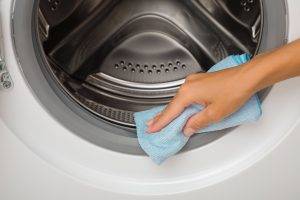
The gasket has deep folds and ridges that trap water, lint, hair, and detergent residue after every cycle. Those folds are easy to forget about. Moisture sits in them, residue provides a food source for odour-causing bacteria, and because the door is usually closed between washes, there’s no airflow to dry things out. Over time, this leads to the musty smell that front-loader owners commonly experience. Left unaddressed for long enough, buildup in the gasket can eventually degrade the rubber itself, leading to leaks that require a service call. It’s a situation that is straightforward to avoid.
Wiping down the gasket after every wash—pulling back the folds and drying the interior surface with a cloth—takes about 30 seconds and prevents buildup from ever taking hold. A solution of equal parts water and white vinegar on the cloth once a week adds mild antibacterial action without damaging the rubber. Several machines make this easier by design, Miele front-loaders feature a honeycomb-textured drum that minimizes fabric and residue contact with the drum surface, reducing the amount of material that makes its way into the gasket folds in the first place.
How Detergent Choice Makes It Worse (or Better)
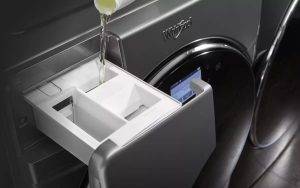
The type of detergent you use and how much of it you use has a direct impact on whether odour develops in your front-loader.
Using regular detergent in an HE machine is one of the fastest ways to create a smell problem. Regular detergent is formulated for machines that use large volumes of water to rinse suds away. HE machines use a fraction of that water, which means excess suds have nowhere to go. They build up in the drum, the gasket, and the dispensing drawer, creating exactly the residue layer that causes odour over time. HE detergent is low-sudsing by design — it cleans effectively in low-water environments and rinses away cleanly.
Using too much of even the right detergent creates the same problem at a smaller scale. The recommended amount for a standard HE load is around one to two tablespoons of liquid detergent. Most people pour significantly more than that, especially when using liquid directly from a large container with a wide cap. More detergent does not mean cleaner clothes — it means more residue, more buildup, and over time, more smell.
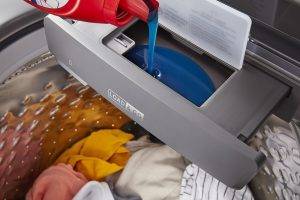
Some washing machines take the guesswork out entirely. LG’s ezDispense system, available on models like the WM6700HBA, automatically measures and dispenses the precise amount of detergent needed for each load based on load size — removing the risk of overdosing. Miele’s TwinDos system does the same, automatically dispensing the correct amount of their two-phase liquid detergent and using up to 40% less than manual pouring. Both systems directly reduce the residue buildup that leads to odour. Fabric softener compounds the issue further. It leaves a heavier residue than detergent and builds up in the dispensing drawer particularly quickly. If you use fabric softener regularly in a front-loader, cleaning the dispensing drawer monthly is essential.
The Role of Leaving the Door Closed
This is the single most common contributor to front-loader odour, and the fix is the simplest one on this list. When the wash cycle ends and the door is closed, the moisture inside the machine has nowhere to escape. The drum stays damp. The gasket stays damp. The dispensing drawer stays damp. That moisture, combined with detergent residue and warmth, creates the conditions for odour to develop.
Leaving the door ajar after every cycle — even just a few inches — allows air to circulate through the drum and gasket, drying out the interior between washes. It’s a habit that takes no effort and makes a significant difference over time.
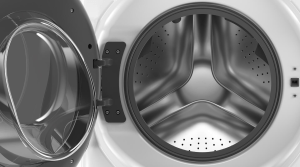
Several machines address this proactively. LG’s Fresh Hold feature, available across much of their
front-load lineup including the WM5800HV A, periodically tumbles the drum after the cycle ends to keep air moving through the load and prevent moisture from settling, useful for households where laundry sometimes sits in the machine before being moved. Whirlpool’s FanFresh option works similarly, using a fan to circulate air through the drum for up to 16 hours after the cycle ends, actively drying out the interior rather than relying on passive airflow. Both features are worth knowing about if keeping the machine fresh between washes is a priority.
Most front-load washers also include a drain pump that removes residual water from the drum at the end of the cycle, ensuring that water isn’t simply pooling at the bottom of the machine between washes. On well-maintained machines this works reliably, but keeping the drain pump filter clean ensures it continues doing its job effectively.
The dispensing drawer benefits from the same logic as the door. Pulling it out slightly after each wash allows it to dry out between cycles rather than sitting sealed and damp.
How to Get Rid of an Existing Smell
If the smell is already there, the approach is straightforward, it requires addressing all the places residue has built up, not just running a hot cycle and hoping for the best.
Start with the gasket. Pull back every fold of the rubber seal and wipe it down thoroughly with a cloth dampened with a solution of equal parts water and white vinegar, or a dedicated washing machine cleaner. For more stubborn buildup, a small amount of diluted bleach solution—one part bleach to ten parts water—applied with an old toothbrush is effective. Let it sit for a few minutes before wiping clean, then rinse and dry the gasket completely.
Next, clean the dispensing drawer. Remove it entirely if your machine allows, most front-loaders have a release tab that lets the drawer pull out fully. Soak it in warm soapy water, scrub the compartments with a small brush, and rinse before reinserting. Then run a drum clean cycle. Most modern front-loaders have a dedicated Drum Clean or Tub Clean cycle (available on LG, Samsung, Bosch, Whirlpool, and Miele machines) which runs at high temperature without laundry inside to sanitize the drum and flush out residue. Add a drum cleaning tablet or a cup of white vinegar directly into the drum before running it. Do not use both at the same time. After the cycle, wipe down the drum interior with a dry cloth and leave the door open to finish airing out.
Simple Habits That Prevent Odour From Coming Back
Once the machine is fresh, keeping it that way comes down to a few consistent habits:
- Leave the door ajar after every cycle
- Wipe down the gasket folds after every wash, or at minimum once a week
- Pull the dispensing drawer out slightly after each use to let it dry
- Use HE detergent and use the correct amount — around one to two tablespoons per standard load
- Avoid fabric softener where possible, or clean the dispensing drawer monthly if you use it regularly
- Run a drum clean cycle once a month with a dedicated cleaner
- Clean the dispensing drawer fully once a month
Done consistently, these habits make front-loader odour essentially a non-issue, and they protect the gasket and the machine over time.